If you are unsure, leave it on Placidus, the default. If you mainly use traditional techniques, choose Whole Sign. Pick any of the other systems to match the school you are studying.
A house system is the method used to divide the chart circle into 12 houses. Different house systems place the house boundaries (cusps) at different degrees, which can change which house a planet falls in. HOSHIDOU supports seven house systems.
How to change
Open Display settings with the gear on a chart screen, Home, or Ephemeris. On the Calc & tables tab, under Calculation, open the House System dropdown and choose the system you want. The chart updates right away.

Choosing a preset on the Look tab also switches the house system (Modern and Evolutionary use Placidus, Traditional uses Whole Sign).
High-latitude birthplaces
At high latitudes, where Placidus and Koch cannot be worked out, the chart may show cusps from a different method instead. The app gives no warning. For birthplaces near the Arctic or Antarctic Circle, use Whole Sign or Equal.
Supported house systems
Placidus
- Method. A time-based (temporal) system. It divides the time a degree of the ecliptic takes to rise from the horizon to the meridian into equal parts, then projects those time divisions back onto the ecliptic to set the house cusps.
- Use it when. You want maximum compatibility with the literature. The vast majority of books, other astrology apps, and online resources assume Placidus, so it is the easiest system to cross-reference while you learn. It is the default in HOSHIDOU.
- Caveat. Near the polar circles (above roughly 66° latitude), degrees of the ecliptic that never rise or set break the time-division logic, and house sizes become extremely distorted. See “High-latitude birthplaces” above.
Whole Sign
- Method. A sign-based (ecliptic) system. The entire sign containing the Ascendant becomes the 1st house, the next sign the 2nd house, and so on. Every house occupies one complete zodiac sign (30°) and house cusps coincide with sign boundaries.
- Use it when. You practice traditional or Hellenistic techniques, or want houses that are easy to read. Because the assignment depends only on the Ascendant’s sign, it behaves the same wherever you were born and stays stable at high latitudes, so it is a reliable choice for polar or near-polar birthplaces.
- Caveat. The MC does not always start the 10th house. It can fall in the 9th or 11th house.
Koch
- Method. A time-based system like Placidus. It works out the intermediate cusps from the semi-diurnal arc of the MC degree (the rising time at the birthplace), not from each cusp’s own degree. House sizes tend to differ somewhat from Placidus.
- Use it when. Your training or reference materials follow the Koch convention. It has been widely used by astrologers in German-speaking countries.
- Caveat. Like Placidus, Koch degrades badly near the poles. It relies on the same rising-time geometry, so it becomes unreliable or undefined at high latitudes, and the two systems can diverge noticeably even at moderately high latitudes.
Regiomontanus
- Method. A space-based (spatial) system. It divides the celestial equator into 12 equal arcs and projects those divisions through great circles onto the ecliptic to determine the house cusps.
- Use it when. You work in horary astrology (the branch that answers a question from the chart of the moment) or classical astrology, where it has long been used, or you follow older source texts that assume Regiomontanus houses.
- Caveat. It stays mathematically defined at much higher latitudes than Placidus or Koch, though the intermediate houses can still become quite uneven as you approach the poles.
Campanus
- Method. A space-based system that divides the prime vertical (the great circle running east-west through the zenith) into 12 equal arcs, then projects them onto the ecliptic. Each house occupies the same spatial extent of sky measured along that reference circle.
- Use it when. You value spatial symmetry in house division, or you are exploring the local-space dimension of a chart.
- Caveat. Like Regiomontanus, it stays mathematically defined at higher latitudes than the temporal systems, but house sizes projected onto the ecliptic grow increasingly distorted the closer the birthplace is to the poles.
Equal
- Method. An ecliptic-based system that assigns exactly 30° to each house, measured from the precise degree of the Ascendant. If the Ascendant is at 14° Taurus, every cusp falls at 14° of its sign.
- Use it when. You want even, predictable houses anchored to the precise Ascendant, or a stable alternative to quadrant systems.
- Caveat. The MC does not necessarily fall on the 10th house cusp; it is usually shown separately. Because the system depends only on the Ascendant degree, it stays stable at high latitudes.
Porphyry
- Method. The simplest of the quadrant systems. It trisects each of the four quadrants formed by the ASC-MC, MC-DSC, DSC-IC, and IC-ASC axes, dividing each quadrant’s ecliptic arc into three equal parts.
- Use it when. You want angular houses without the heavier trigonometry of Placidus, Koch, Regiomontanus, or Campanus. It is an accessible entry point if you are moving from Whole Sign toward quadrant-based interpretation, because it keeps the Ascendant and MC on the 1st and 10th cusps.
- Caveat. Because it only divides the ecliptic arcs between the angles, Porphyry stays defined and comparatively stable at high latitudes. The quadrants can become very unequal in size near the poles, but the system never fails outright the way Placidus and Koch do.
What it affects
Changing the house system shifts the house cusp positions. That can move planets into different houses and changes the house cusp table.
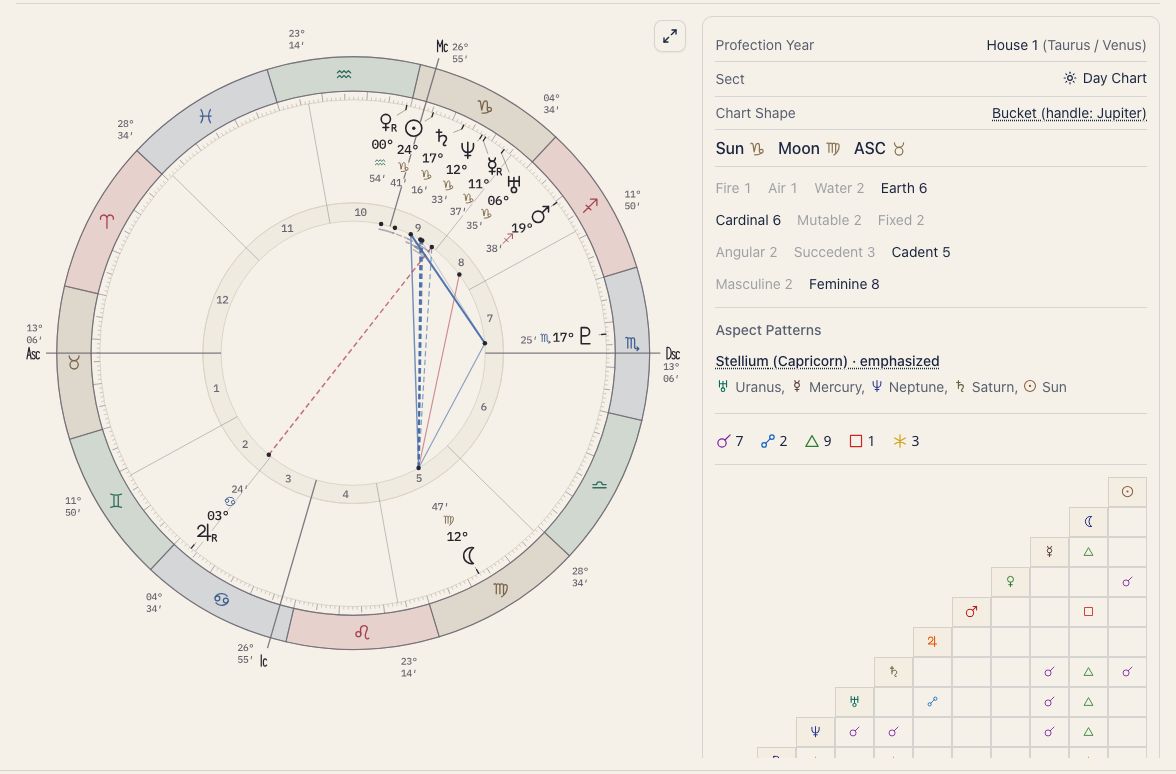
For what each house means, see Houses. To switch the house system together with other settings, see calculation presets.