Harmonic Charts
What harmonic charts show, how to choose a harmonic number, what each common harmonic means, and how to read the chart.
A harmonic chart multiplies each planet’s zodiac longitude by a chosen integer and plots the result, which brings out angular relationships that are hard to spot in a standard natal chart. Fine divisions such as the fifth and seventh harmonics show up as planets lying on top of each other. The name borrows from overtones in music: just as overtones bring out the vibration patterns inside a fundamental note, a harmonic chart emphasizes patterns inside the natal chart.
Use it when you want to check, one at a time, angular relationships that a standard chart makes easy to miss, such as the quintile (72°). It is an applied chart, so read it after you are comfortable with the birth chart and the Single Wheel.
What are harmonic charts
In a standard natal chart, the major aspects (conjunction, square, trine, and so on) get most of the attention. Finer divisions such as quintiles (5th harmonic) and septiles (7th harmonic) are easy to overlook.
A harmonic chart recalculates each planet’s position by multiplying its longitude by the harmonic number and taking the remainder after dividing by 360°. Planets that share the targeted angle in the natal chart then appear as conjunctions.
Septiles and noviles cannot be chosen as aspects. You look at them in the harmonic chart.
How to open it
You open a harmonic chart from Applied charts in the sidebar.
- Choose a person under Birth Details in the sidebar
- Select “Harmonic” under Applied charts
- Choose a harmonic number
You can also press the chart title on any chart screen and switch to it from there.
Choosing a harmonic number
Enter a number from 2 through 36 in the Harmonic number field at the top of the screen. The H2, H4, H5, H7, H8, H9, H12, and H16 buttons are shortcuts. H4 is selected at first. The chart recalculates right away each time you change the number.
Different numbers bring out different aspect families. Choose the number that matches what you want to look at.
Common harmonics and their meanings
Each harmonic number has its own theme. The table lists the numbers used most often.
| Number | Aspect highlighted | Theme |
|---|---|---|
| H2 | Opposition (180°) | Polarity, tension and integration |
| H4 | Square (90°) | Drive, conflict, growth through challenge |
| H5 | Quintile (72°) | Creativity, talent, unique self-expression |
| H7 | Septile (about 51.4°) | Inspiration, unconventional ideas |
| H8 | Semi-square (45°) | Transformation, growth through crisis |
| H9 | Novile (40°) | Maturity, refinement, sense of fulfilment |
| H12 | Semi-sextile (30°) | Subtle adjustment, latent ability |
Reading the chart
In a harmonic chart, look first at the conjunctions (0°). Planets that formed the targeted angle in the natal chart now sit together.
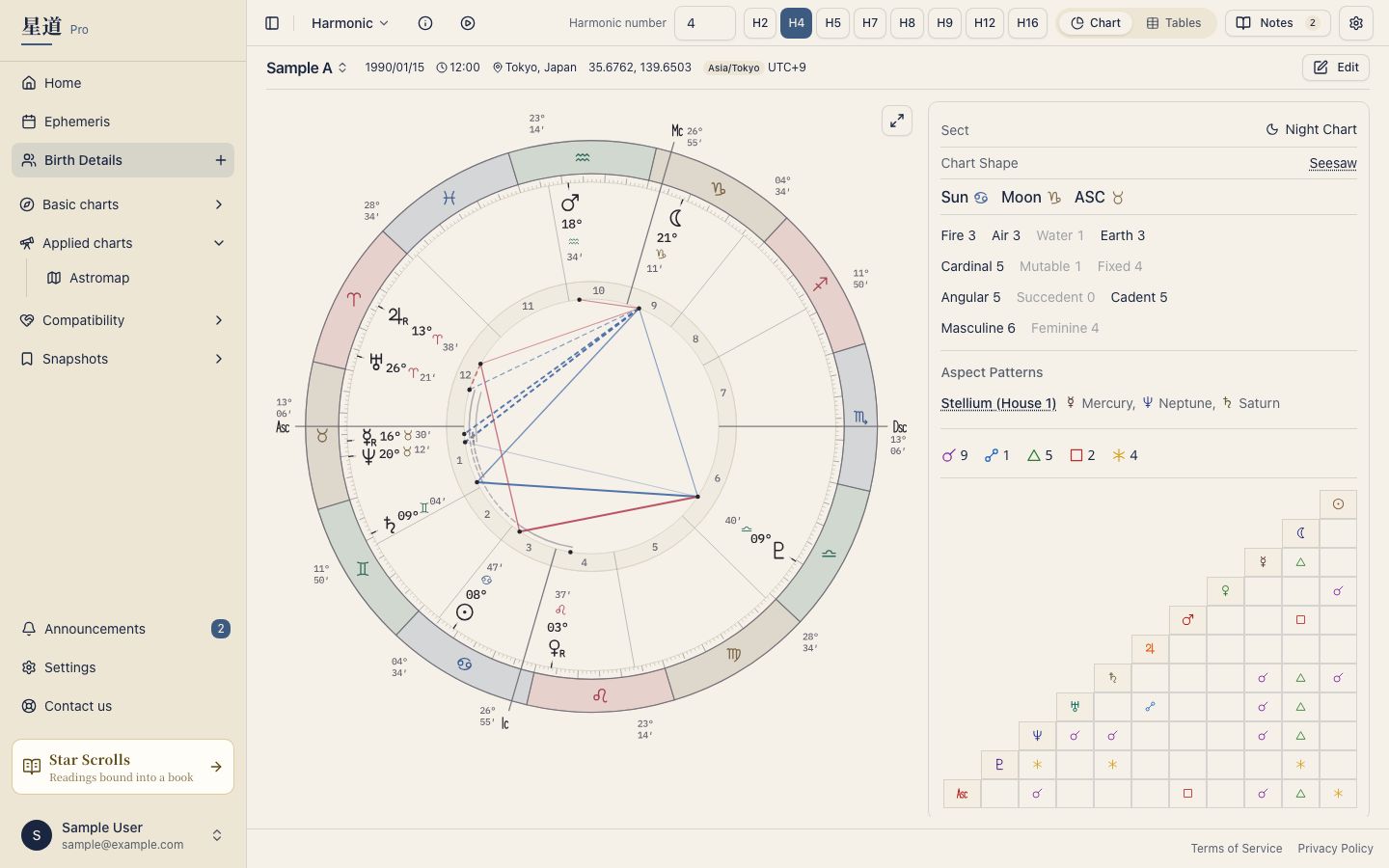
- Tight conjunctions: the harmonic’s theme is working strongly
- Multi-planet clusters: several of your strengths overlap around that theme
- Aspect patterns: Grand Trines, T-Squares, and other figures that appear in the harmonic chart are also worth reading
Comparing it with the natal chart deepens the picture. You can view the natal chart via Single Wheel.
Tables and tooltips
Harmonic charts have the same data panel and table view as the Single Wheel, including the planet table. Hover over a planet glyph (press it on a phone) to see a tooltip with the harmonic-adjusted degree.
You can change tooltip content in Tooltip Settings.