Aspect Patterns
How to read special aspect patterns, such as the Grand Trine and Grand Cross, and how HOSHIDOU displays them on your charts.
A special aspect pattern (aspect configuration) is a placement where three or more planets combine to form a single geometric figure. These figures show structure and themes across the chart that you would miss by reading individual aspects one line at a time.
HOSHIDOU automatically detects aspect patterns on the natal chart and several other charts, and lists them in a panel beside the wheel.
Where they appear
The aspect-pattern list appears on the following charts. When no pattern is detected, the list is hidden.
- Single Wheel (natal): shown in the panel to the right of the chart.
- Derived single charts: single-wheel views such as progressed, Solar Return, Lunar Return, Solar Arc, and Draconic.
- Composite chart: patterns are also detected on the relationship chart built from two people’s midpoints.
When you view progressed or transit positions, the heading switches to “Aspect Patterns (Progressed)” or “Aspect Patterns (Transit)”, so you can tell which chart a figure belongs to.
Reading the list
Each entry in the list has these parts:
- Pattern name: the name of the detected figure, such as “Grand Trine” or “T-Square”.
- Parenthetical qualifier: a short note in parentheses. A Grand Trine shows its shared element (fire, earth, air, water); a T-Square or Grand Cross shows its modality (Cardinal, Fixed, Mutable); a Stellium shows the sign or house where the planets cluster (for example House 5).
- Strong: a configuration that stands out, such as a Stellium of four or more planets, is tagged “Strong”.
- Member planets: the planets that form the figure, listed by glyph and name. In a T-Square, Yod, or Kite, the apex, where the tension or adjustment gathers, is marked with ”*”.
Hover over a row to make its figure stand out on the wheel; press it to keep it selected. Hover over the pattern name to see a tooltip with its interpretation (on a phone, press “Show reading” to open it under the row). For figures with an apex, the tooltip footer also names the focal planet as “Apex: ___”. For the aspects themselves, see Aspects.
The six aspect patterns
HOSHIDOU detects six chart patterns. The Stellium is a cluster of planets in one sign or house.
| Pattern | Geometry | Keywords |
|---|---|---|
| Stellium | Three or more planets in one sign or house | concentration, emphasis |
| Grand Trine | An equilateral triangle of 120° trines | harmony, talent |
| T-Square | An opposition plus two squares to an apex | tension, drive |
| Grand Cross | Two oppositions crossing at right angles | tension in four directions, persistence |
| Yod | A sextile plus two quincunxes to a common planet | adjustment |
| Kite | A Grand Trine plus a fourth “tail” planet | outlet for talent |
Stellium
Three or more of the planets on display in the same sign or the same house. Attention tends to gather in the area of life that sign or house describes, and strengths and difficulties alike concentrate there. A cluster of four or more is tagged “Strong”. When the same set of planets shares both a sign and a house, the sign and house count as one stellium.
Grand Trine
Three planets linked by 120° trines, forming an equilateral triangle. They usually share one element (fire, earth, air, water), and that element’s strengths tend to flow easily. The ease can also make it tempting to lean on that strength alone.
T-Square
An opposition (180°) whose two ends both square (90°) a third planet, the apex. Tension gathers at the apex. It becomes the point of conflict and also the push that moves things forward.
Grand Cross
Two oppositions crossing at right angles, joined by four squares. It is a T-Square extended into a full cross, and it tends to carry tension from four directions at once. When you learn to work with that tension, it shows up as persistence.
Yod
Two planets in a sextile (60°) base both reaching a common third planet by quincunx (150°). The apex planet’s theme tends to need repeated adjustment. Some astrologers call it the “Finger of God”.
Kite
A Grand Trine plus a fourth planet (the tail) that opposes one vertex and sextiles the other two. The triangle’s harmony gains a direction and an outlet, so talent that merely flowed can turn into concrete action more easily.
Orbs and settings
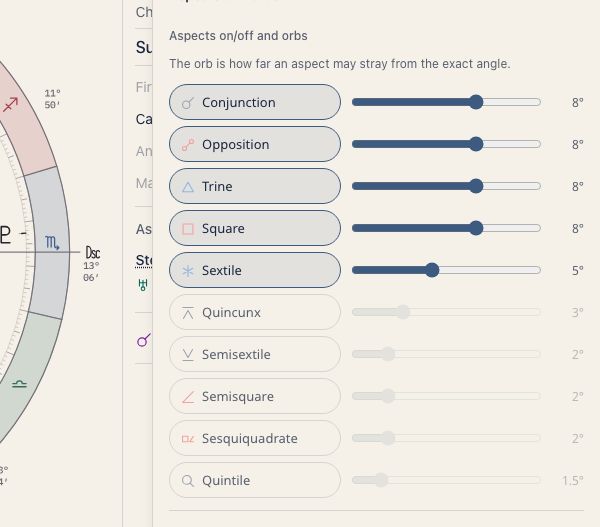
Each figure is detected when its aspects fall within their allowed orb. A Yod appears only when the quincunx is turned on in the aspect settings (it is off by default), and its two quincunxes count only within a 3° orb. You can change which bodies are displayed and adjust orb values on the Bodies and Aspects tabs of Display settings (the gear in the top right of the chart screen). See Points & Aspects Settings. Changing these settings can change which patterns are detected.
Overlapping figures
When figures overlap, HOSHIDOU tidies the list. A T-Square that sits entirely inside a Grand Cross is left out as a duplicate. A Kite is listed alongside the Grand Trine it contains.