Houses
The meaning of the 12 astrological houses, the 4 angles, and how empty houses work.
The 12 houses divide the chart into life domains — career, partnership, home, money, and so on — telling you where in a person’s life a given planetary energy plays out.
What are houses?
Houses divide the chart into 12 sectors, each representing a specific area of life such as career, relationships, or home. While zodiac signs describe how energy expresses itself, houses describe where that energy shows up.
House boundaries are calculated from your exact birth time and location. This is why accurate birth details matter so much — even a few minutes can shift house cusps and change which house certain planets fall in.
The 4 angles
Four of the 12 house cusps hold special importance. Known as the “angles,” they sit at the cardinal points of the chart and define the core axes of your life.
| Angle | Abbreviation | Position | Meaning |
|---|---|---|---|
| Ascendant | ASC | Eastern horizon | Outward persona, first impressions, the sign rising at the moment of birth |
| Imum Coeli | IC | Where the meridian meets the ecliptic, the lower point (toward the nadir) | Inner foundation, home environment, roots |
| Descendant | DSC | Western horizon | How you relate to others, the partner you attract |
| Midheaven | MC | Where the meridian meets the ecliptic, the upper point (toward the zenith) | Career direction, public reputation, life goals |
In Placidus and similar quadrant systems, the ASC starts the 1st house, the IC the 4th, the DSC the 7th and the MC the 10th. In Whole Sign and Equal House, the MC and IC do not start a house. In Whole Sign, the MC can fall in the 9th or 11th house, and the IC in the 3rd or 5th.
The ASC-DSC axis represents the “self versus other” polarity, while the IC-MC axis represents the “private life versus public life” polarity.
The 12 houses at a glance
The table below summarizes each house, its life domain, natural sign, and key themes.
| House | Life Domain | Natural Sign | Keywords |
|---|---|---|---|
| 1st House | Self and identity | Aries | Appearance, first impressions, ego, physical constitution |
| 2nd House | Money and possessions | Taurus | Income, values, talents, material security |
| 3rd House | Communication | Gemini | Conversation, learning, siblings, short trips |
| 4th House | Home and family | Cancer | Family, residence, roots, emotional security |
| 5th House | Creativity and joy | Leo | Hobbies, romance, children, self-expression |
| 6th House | Health and daily work | Virgo | Routines, workplace, wellness, service |
| 7th House | Partnership | Libra | Marriage, business partners, contracts, open enemies |
| 8th House | Shared money and deep change | Scorpio | Inheritance, joint finances, deep bonds, deep change |
| 9th House | Exploration and philosophy | Sagittarius | Higher education, religion, long-distance travel, worldview |
| 10th House | Career and public standing | Capricorn | Profession, social reputation, achievement, authority |
| 11th House | Friends and community | Aquarius | Peer groups, organizations, hopes, future vision |
| 12th House | Rest, solitude and things behind the scenes | Pisces | Unconscious, secrets, solitude, quiet time |
Each house explained
1st house: self and identity
The house of you. It governs your outward appearance, first impressions, physical constitution, and general approach to life. The Ascendant (ASC) marks its cusp, making this house the starting point of the entire chart.
2nd house: money and possessions
The house of personal resources. It reveals how you earn money, your spending habits, and what you value most. Talents and self-worth also fall under this house.
3rd house: communication
The house of everyday communication. It covers how you speak, write, and learn, as well as relationships with siblings and neighbors. Short-distance travel and local errands belong here too.
4th house: home and family
The house of private life and emotional foundations. It relates to your family upbringing, living situation, and sense of belonging. The IC marks its cusp (except in Whole Sign and Equal House), and this house also touches on the later years of life.
5th house: creativity and joy
The house of self-expression and pleasure. Creative projects, romantic affairs, hobbies, and children all fall here — anything that makes your heart light up.
6th house: health and daily work
The house of routines and well-being. It encompasses your daily work habits, workplace environment, health management, and acts of service to others.
7th house: partnership
The house of one-to-one relationships. It describes the qualities you seek in a marriage or business partner, how you handle contracts and negotiations, and your “open enemies” — people who openly oppose you. The Descendant (DSC) marks its cusp.
8th house: shared money and deep change
The house of deep change and what you receive through others. Inheritance, insurance, a partner’s assets, and profound psychological transformation are all 8th-house themes.
9th house: exploration and philosophy
The house of the broader horizon. Higher education, foreign travel, religion, philosophy, and the legal system belong here — anything that expands your understanding beyond the everyday.
10th house: career and public standing
The house of your place in the world. It reveals your career path, ambitions, and how the public perceives you. The MC (Midheaven) marks its cusp (except in Whole Sign and Equal House), making it one of the most visible points in the chart.
11th house: friends and community
The house of social circles and shared ideals. Friendships, group memberships, community involvement, and your hopes for the future are governed by this house.
12th house: rest, solitude and things behind the scenes
The house of what lies beneath the surface. Time alone, feelings you do not show, secrets, and matters that happen behind the scenes all sit here. It is the house of endings and letting go, a quiet space for inner reflection.
How houses appear in HOSHIDOU
In HOSHIDOU’s single wheel and triple wheel views, houses are displayed as numbered wedge-shaped sectors radiating out from the center of the wheel. Each sector is labeled 1 through 12, so you can immediately see which house a planet occupies.
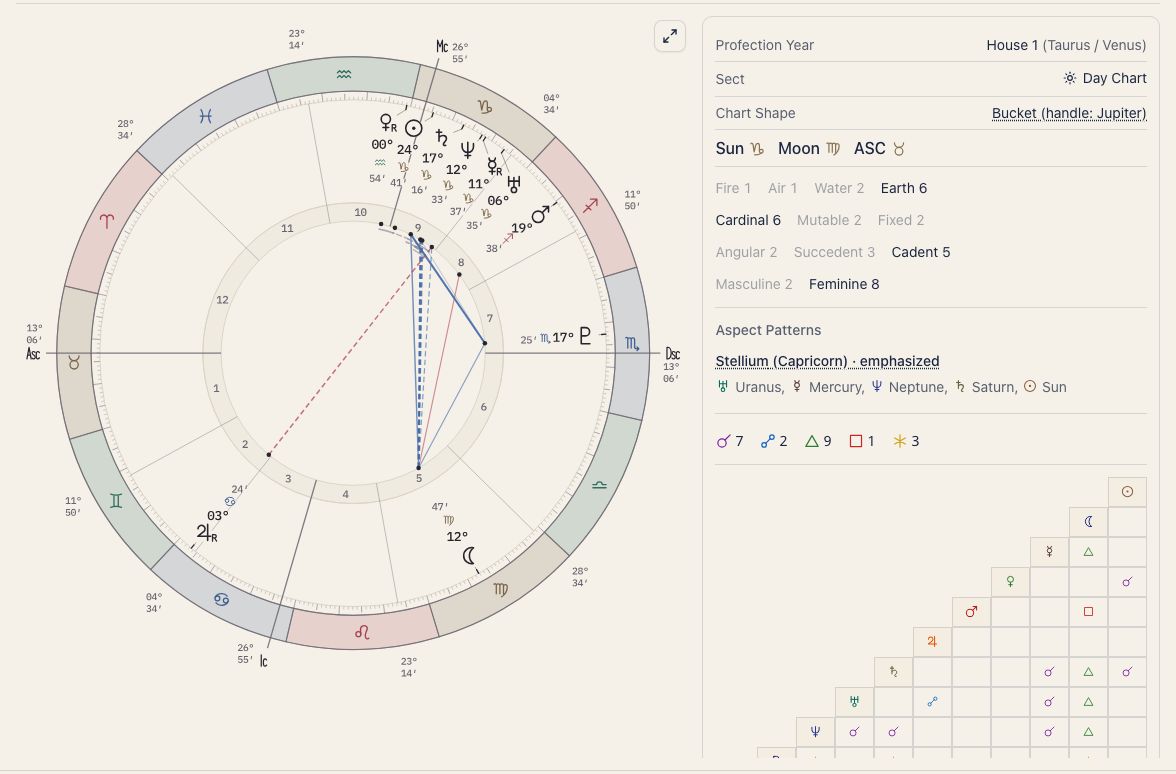
Switch to Table at the top of the single wheel to see the house cusp table, which lists the exact sign and degree of each house boundary. Checking the cusp sign is especially useful for reading empty houses, since it tells you which sign’s energy colors that life domain.
House system setting
There are several methods for dividing the wheel into houses, known as house systems. HOSHIDOU supports multiple house systems. Placidus is the default, but you can switch to another system at any time.

See House System setting for details on how to change it.