Compatibility Score
How to read the compatibility score, understand the six category breakdowns, and how scores are calculated.
The Compatibility Score turns the angles between two people’s natal charts into numbers. It shows an overall percentage and six category scores, so you can look at how the two people interact from several directions. The numbers are a starting point for reading. They do not decide whether a relationship is good.
Opening it, and the plan
Open Compatibility Score from Compatibility in the sidebar. Choose the first person under Birth Details, then choose the second with Select Person B at the top of the chart. A birth time is needed only for the first person. If the second person’s birth time is unknown, noon is used, so do not rely on that person’s ASC.
Compatibility Score requires the Hoshigatari plan or above. On the free Hoshiyomi plan, the screen shows a plan prompt and the second-person picker is disabled.
You can also press the chart title to switch to another chart.
Overall score
At the top of the screen, the overall score appears as a percentage (for example, 70%). It starts at 50%. A score below 50% means the subtractions from the angles add up to more than the additions. It is not a verdict on the relationship.
Beside it, Activity is the total size of all the additions and subtractions, with the plus and minus signs ignored. The higher it is, the more angles there are between the two charts, or the closer they are to exact.

The overall score is the average of the six category scores.
Category scores
There are six categories, each scored out of 100. Each category looks at a fixed set of planet pairs. A pair counts whichever person’s planet comes first.
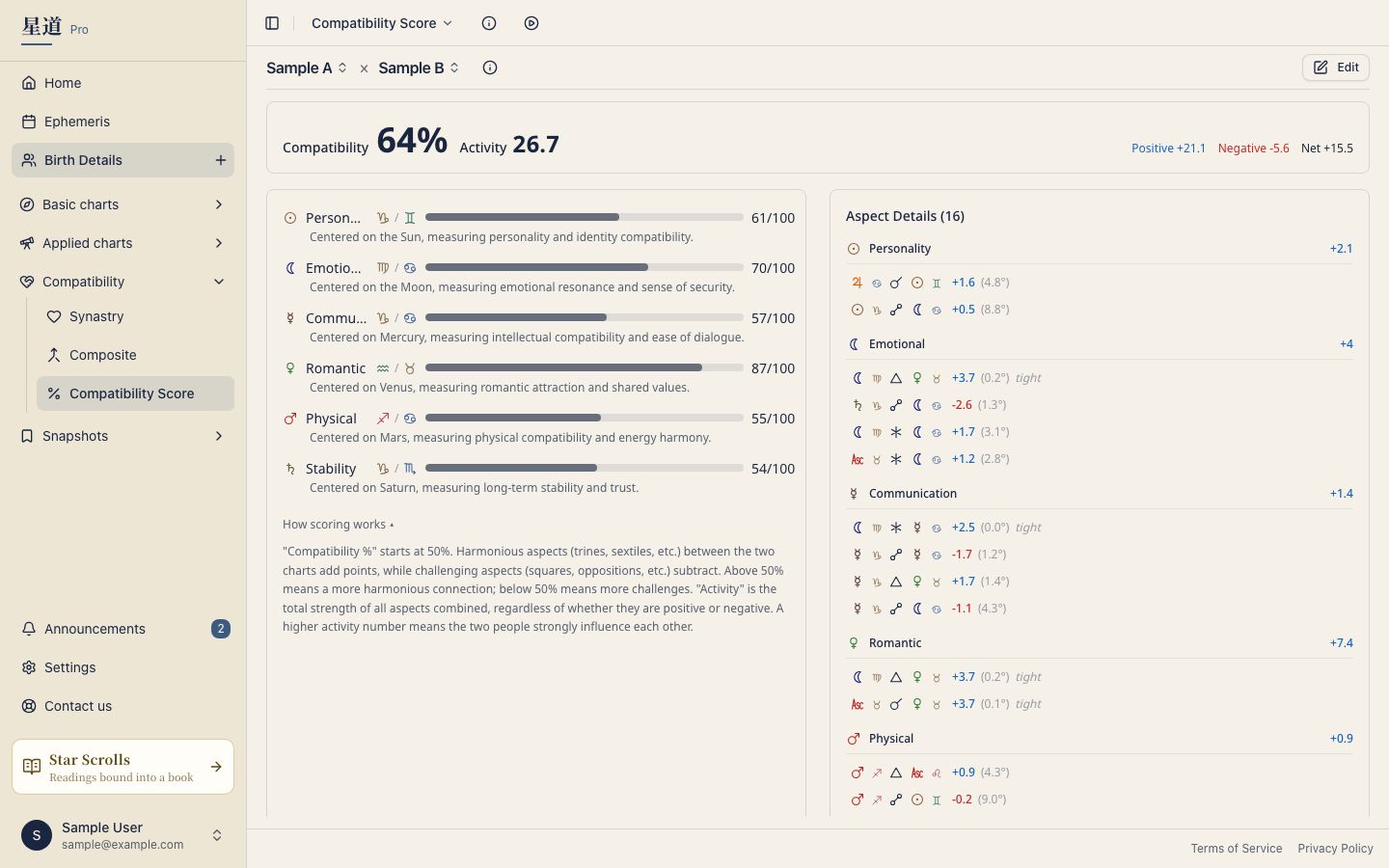
Personality
Centered on the Sun: how the two people’s self-expression fits. Pairs: Sun-Sun, Sun-Moon, Sun-ASC, Sun-Jupiter.
Emotional
Centered on the Moon: emotional resonance and a sense of ease. Pairs: Moon-Moon, Moon-Venus, Moon-ASC, Moon-Jupiter, Moon-Saturn.
Communication
Centered on Mercury: how conversation and ways of thinking fit. Pairs: Mercury-Mercury, Mercury-Sun, Mercury-Moon, Mercury-Venus, Mercury-Jupiter.
Romantic
Centered on Venus: attraction and how affection is shown. Pairs: Venus-Venus, Venus-Sun, Venus-Moon, Venus-Mars, Venus-ASC, Venus-Jupiter.
Physical
Centered on Mars: physical compatibility and how energy is matched. Read it as how the two people’s drive and energy fit together. Pairs: Mars-Venus, Mars-Mars, Mars-Sun, Mars-Moon, Mars-ASC.
Stability
Centered on Saturn: the footing for keeping something going over time. Pairs: Saturn-Sun, Saturn-Moon, Saturn-Venus, Saturn-ASC, Jupiter-Saturn.
Aspect detail list
Beside the categories (below them on a phone), a list shows the individual aspects that feed the score. Each entry shows the pair (for example, Sun trine Moon) and its orb value, the distance from the exact angle.
You can see which aspects raise a category and which lower it.
How scores are calculated
- Which angles count: conjunction, opposition, trine, square, and sextile. Each planet pair has its own weights, and a conjunction can add or subtract depending on the pair
- Which bodies count: the Sun through Saturn, and the ASC (ASC to ASC included; the MC is not). Bodies you hide in Display settings are not counted. If you add bodies such as Chiron or the Nodes in settings, they count too
- Orbs: compatibility uses its own orbs. They start at the same values as the natal chart, with extra allowance when the Sun or Moon is involved
- Exactness: the closer an angle is to exact, the more it weighs, and within 1° it weighs more still
- Category scores: each of the six categories starts at 50 and moves up or down with the additions and subtractions from its angles
- Overall score: the average of the six categories
- Soft and hard: trine and sextile are soft, square and opposition are hard, but the actual addition or subtraction comes from the weight set for each pair
The “How scoring works” note on screen sums up these same rules.
A Star Scroll for the two of you
Once you have selected two people and the score appears, the Create a report for these two button is shown below it. It opens the creation page with both people already selected, so you can read the placements behind the score as a written Star Scroll. You check who it is for and what is inside on the next screen before going further. The score in the Star Scroll is calculated with the same settings as this screen.
Related pages
- Synastry: the inter-chart aspects these scores come from, shown on a wheel.
- Composite Chart: a different way to read the same two people, as a single chart.