Sect
How to read whether a chart is a day chart or night chart, and what sect means for the planets.
Sect is a foundational concept in Hellenistic astrology that sorts every chart into one of two kinds: a day chart or a night chart. If the Sun was above the horizon at the moment of birth, the chart is a day (diurnal) chart. If the Sun was below the horizon, it is a night (nocturnal) chart. This one fact changes how the whole chart is read. The technique is written for people who are studying astrology, so come to it once you are comfortable with the Single Wheel.
How to open it
Sect appears as a row in the Single Wheel’s data panel, with a sun or moon icon and the words Day Chart or Night Chart, so the chart’s sect is clear at a glance.
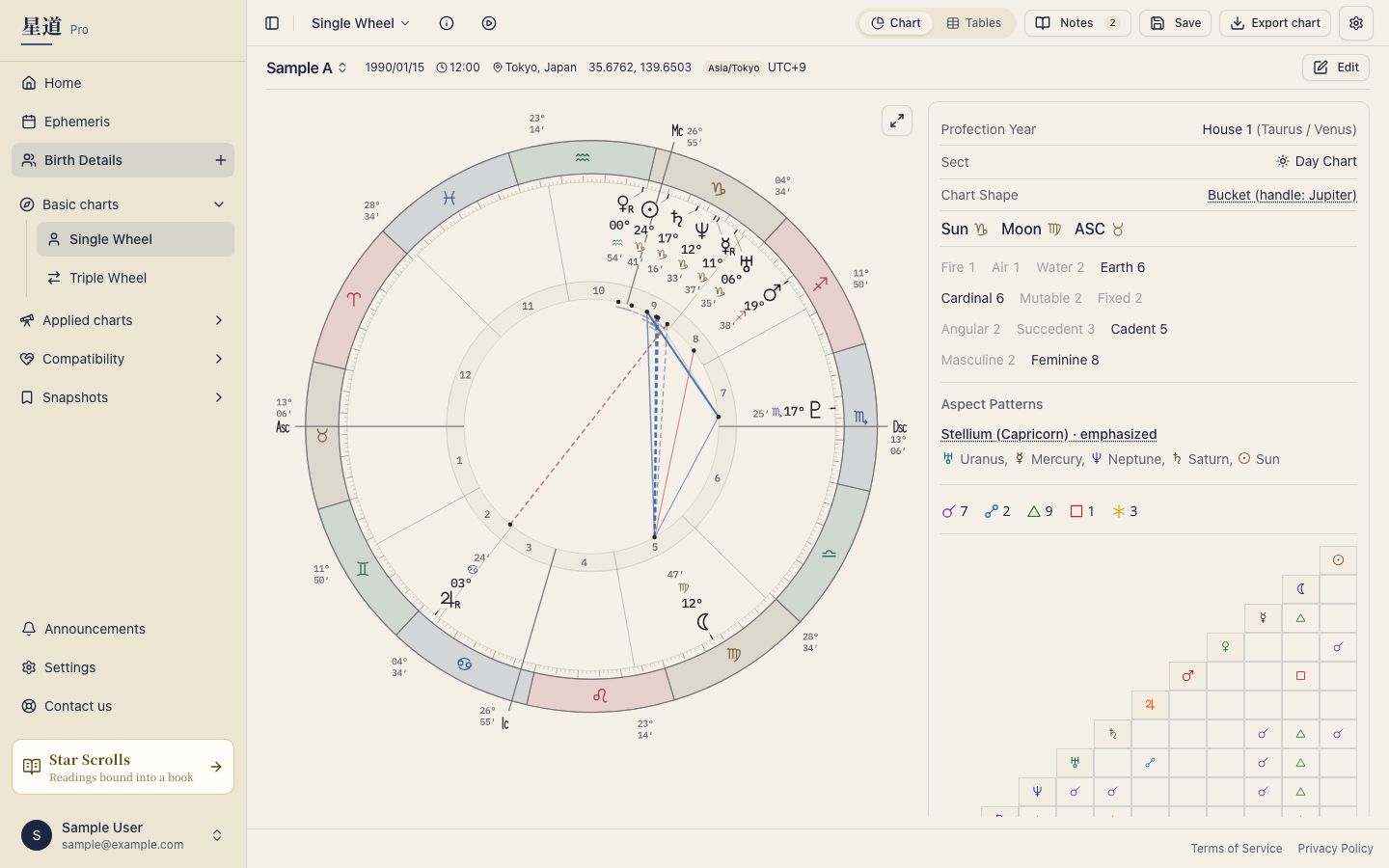
The Sect row is on from the start. To turn it off or on again:
- Open the gear in the top right of the chart screen (Display settings).
- On the Calc & tables tab, under Tables and badges, switch Show sect.
How day and night are decided
The app treats the chart as a day chart when the Sun is in houses 7 to 12, and as a night chart when the Sun is in houses 1 to 6. The house boundaries come from the house system you have chosen, so a chart near the boundary can change with the system. The app does not treat Mercury as a morning or evening star.
The sect light
Each chart has a “sect light”, the luminary that leads the chart:
- Day chart: the Sun is the sect light.
- Night chart: the Moon is the sect light.
The sect light is traditionally read as the most important indicator of the vitality of the whole chart.
Benefics and malefics of sect
Sect also changes how the benefic and malefic planets behave. Each chart has one benefic and one malefic that match its sect and tend to work more constructively, and one of each that go against the sect and tend to be harder.
- Day chart: Jupiter is the benefic of sect and Saturn the malefic of sect. Both are considered better behaved by day.
- Night chart: Venus is the benefic of sect and Mars the malefic of sect. Both are considered better behaved by night.
As a rule of thumb, a planet “in sect” tends to work more smoothly, and the same planet “out of sect” can be harder to handle, even when it is otherwise well placed.
How to read it
Start by noting whether the chart is a day or night chart. Then find the sect light (the Sun by day, the Moon by night) as the main significator of the life. After that, see which benefic and malefic belong to the sect. That shows which planets tend to help and which you may want to handle more consciously.
Related pages
- Single Wheel: where the day/night row appears.
- Traditional Techniques: dignities, mutual reception, declination, and fixed stars.