Most people who open a natal chart for the first time get stuck in the same place. A dozen-odd symbols inside a circle, lines crossing every which way, and no sense of where to begin reading. I was the same at first.
Let me give you the conclusion first. To start, three are enough. The Sun, the Moon, the Ascendant. Once you can read these three points, you can already see the skeleton of the chart.
The Sun: the direction you reach toward
Your Sun sign (the constellation the Sun was in on the day you were born) is the one the weekly magazine horoscopes use. Because it is the most familiar, it tends to get brushed off, but I think of it as the point that shows which way you want to grow.
An Aries Sun: moving out in front. A Cancer Sun: building a place where someone can feel safe. There is no good or bad to a sign itself. It is a question of which direction your energy runs most honestly when you let it.
The Moon: who you are when you relax
The Moon is the self that comes out when you are alone, or when you let your guard down. If the Sun is “how I want to be,” the Moon is “how I turn out when left alone.”
Plenty of people have a Sun and a Moon in different signs. If anything, that gap is what gives a person their particular texture. Out in the world they push forward with an Aries Sun, yet at home they need solitary time with a Cancer Moon. It looks like a contradiction, and both are true.
The Ascendant: the entrance others see
The Ascendant (the rising sign) is the sign that was climbing over the eastern horizon at the moment you were born. It shows up in first impressions and in how you brace yourself toward the outside world.
To find it, you need your birth time. It is often written in your maternal records, so check if you can. A difference of a few minutes can shift the Ascendant, which is exactly why the time matters so much in a natal chart.
Once you can see the three
When you have the Sun, the Moon, and the Ascendant, you can put yourself into words for now in three layers: the direction you reach toward, who you are at rest, and how you look from outside. The rest of the planets, the houses, the aspects — those are the work of adding flesh to this skeleton. There is no need to rush at reading everything at once.
In HOSHIDOU, the three meet your eye first
Enter your birth details in HOSHIDOU and these three points come up together in a panel on the chart screen.
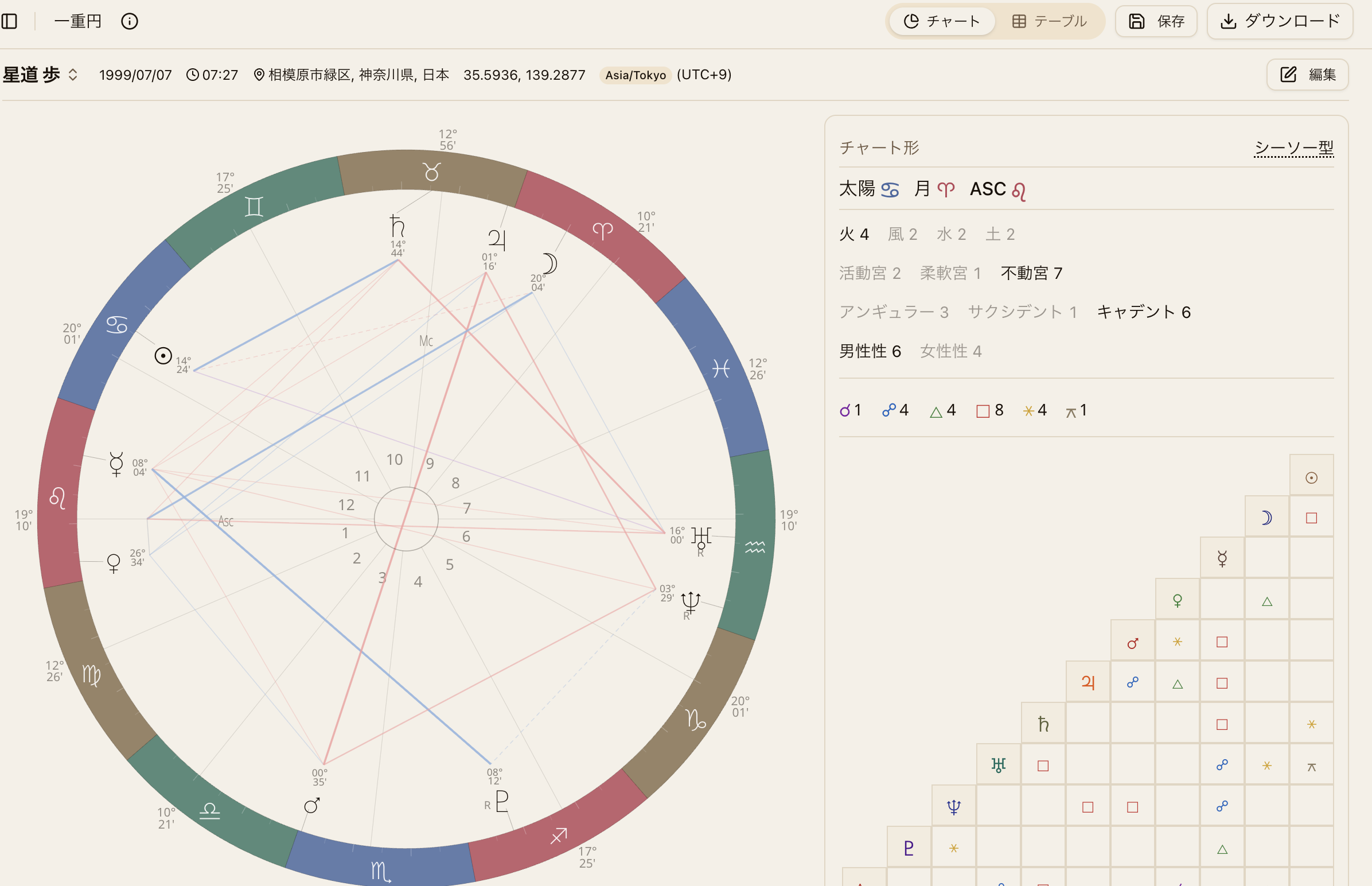
In the example above, the Sun is in Cancer, the Moon in Aries, the Ascendant (ASC) in Leo. Seen from outside the person is a bright Leo, yet the direction they want to head is Cancer, toward protecting someone, and at rest they are an Aries who moves at once. The skeleton of someone whose three points face three different ways comes into view from this alone. Just below, fire 4, air 2, water 2, earth 2 shows the lean of the elements, so you can also see on the same screen which element they run thick in and which runs thin.
You don’t have to know the symbols yet. Rest the cursor on the Aries Moon symbol, for instance (on a phone, tap it), and a tooltip gives the name of the sign and its meaning.
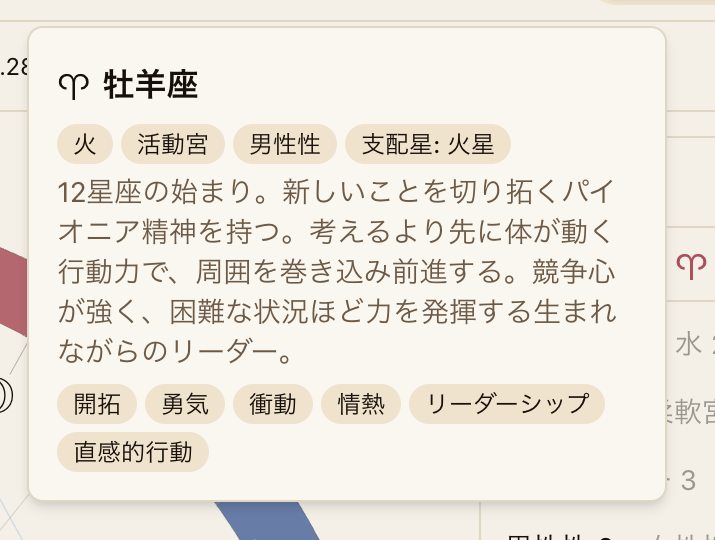
Going back and forth between symbol and sign name, you learn them without trying.
Start by finding the three in your own chart: the Sun, the Moon, and the Ascendant.